Queer Places:
17 Cunningham Pl, London NW8 8JT, UK
17 Glenmore Rd, Belsize Park, London NW3 4BY, UK
St Marylebone Cemetery (now commonly known as East Finchley Cemetery), 122 East End Road, East Finchley, London Borough of Barnet, Greater London N2 0RZ England
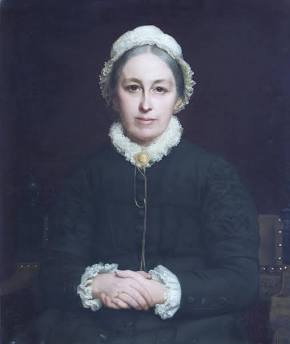 Sarah Emily Davies (April 22, 1830 - July 13, 1921) was one of the most brilliant, unyielding strategists of the Victorian women’s movement. While history often prioritizes the
fiery street protests of later suffragettes, Davies operated in the quiet, foundational trenches of institutional reform. She recognized that true independence for women was
impossible without two pillars: university-level education and the right to vote.
Sarah Emily Davies (April 22, 1830 - July 13, 1921) was one of the most brilliant, unyielding strategists of the Victorian women’s movement. While history often prioritizes the
fiery street protests of later suffragettes, Davies operated in the quiet, foundational trenches of institutional reform. She recognized that true independence for women was
impossible without two pillars: university-level education and the right to vote.
Her crowning achievement was the founding of Girton College, Cambridge—the first residential university college for women in the United Kingdom.
Born Sarah Emily Davies in Southampton, she was the daughter of Mary Hopkinson and John Davies, an evangelical Anglican clergyman. The family moved to Gateshead in 1839,
where her father served as rector.
Like most Victorian girls, Emily’s formal education was severely neglected in favor of domestic duties, while her brothers were sent away to high-quality schools and
Cambridge University. This stark injustice deeply embittered her. She educated herself by devouring books in her father’s study, sparking a lifelong resentment of the
intellectual starvation forced upon women.
Following her father’s death in 1861, she moved to London with her mother, entering a radical new world of progressive activism.
In London, Davies quickly coalesced with the Langham Place Group, a circle of pioneering women who effectively launched the organized feminist movement in Britain. Here,
she formed deep, lifelong alliances with Elizabeth Garrett Anderson (the first openly practicing British woman doctor)
and Barbara Bodichon.
Davies served as the editor of the English Woman's Journal, using it as a megaphone to campaign for women’s employment, legal rights, and higher education. When her close
friend Elizabeth Garrett Anderson struggled to gain admission to medical schools, Davies stepped in as a master strategist, orchestrating a relentless campaign that
eventually forced the Society of Apothecaries to admit women.
Davies firmly believed that women should not be given modified, "easier" versions of education. If women were to prove their intellectual parity with men, they needed to
sit the exact same examinations under the exact same conditions.
In 1862, while living at 17 Cunningham Place, St John's Wood, she formed the School Mistresses’ Association and successfully campaigned to open Cambridge local examinations to girls. But she wanted more than high school
testing; she wanted the university itself.
1869: Davies, along with Barbara Bodichon and Lady Stanley of Alderley, rented a small house for five female students in Hitchin, Hertfordshire. She deliberately chose a
location far enough away from Cambridge to avoid public scandal, but close enough for professors to travel to give lectures.
1873: The community expanded and moved to its permanent site on the outskirts of Cambridge, officially opening as Girton College.
Davies served as Mistress of the college from 1872 to 1875 and remained its strict, uncompromising honorary secretary until 1904. Her insistence on a rigorous,
traditional curriculum—vetoing any attempts to soften the requirements for her female students—laid the groundwork for women's academic credibility worldwide. Ironically,
despite her efforts, Cambridge University refused to grant actual, official degrees to women until 1948, decades after her death.
Education was only half the battle. In 1866, Davies co-organized the historic Suffrage Petition, gathering over 1,500 signatures demanding votes for women. She and
Garrett Anderson famously brought the petition to Parliament hidden under a mince-pie stall to avoid confiscation, handing it to philosopher and MP John Stuart Mill, who
presented it to the House of Commons.
She became a key organizer of the National Society for Women's Suffrage and later the National Union of Women's Suffrage Societies (NUWSS), working closely with
Millicent Garrett Fawcett. As a constitutional suffragist, Davies strongly disapproved of the militant, law-breaking
tactics later adopted by Emmeline Pankhurst's Suffragettes, believing that equality must be won through rigorous debate and
institutional lawmaking.
Davies lived just long enough to see the first fruits of her lifelong struggle. Following the Parliament (Qualification of Women) Act and the Representation of the People
Act, she cast her very first vote in the 1918 general election at the age of 88.
She passed away at her home in Hampstead, London, on July 13, 1921. Her legacy survives not only in the sprawling architecture of Girton College but in every female
academic who followed the trail she stubbornly blazed through the closed doors of British academia.
References:
- https://en.wikipedia.org/wiki/Emily_Davies
- https://www.britannica.com/biography/Emily-Davies
- https://www.encyclopedia.com/women/encyclopedias-almanacs-transcripts-and-maps/davies-emily-1830-1921
Support this project
This website is a passion project researched, developed, and funded entirely by me. If you find the content valuable and would like to help support the ongoing research and hosting costs, any contribution is deeply appreciated.
Thank you for keeping this independent resource alive!
My books on Amazon: Elisa Rolle's books
BACK TO HOME PAGE